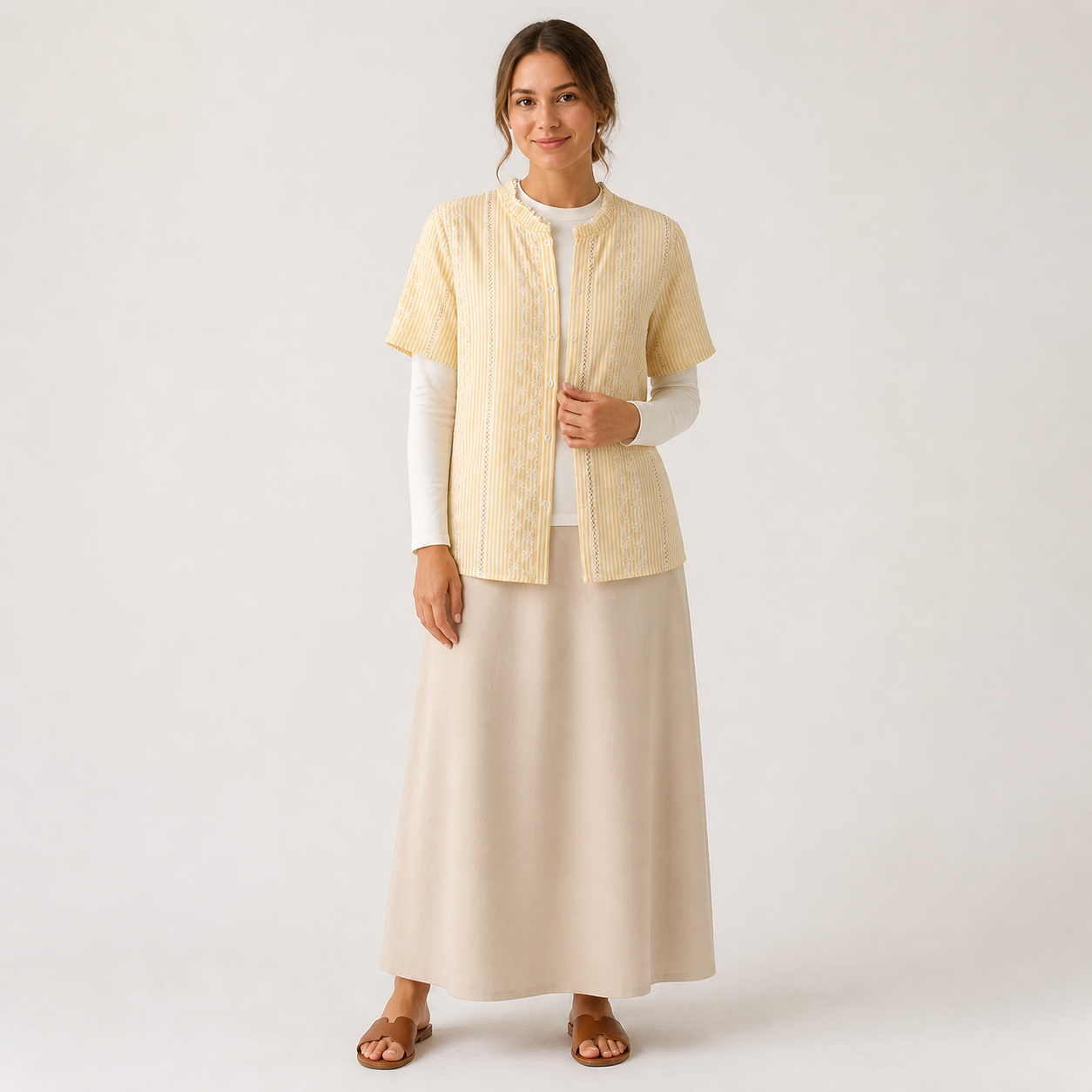
Among modest wardrobe pieces, the blouse is one of the trickiest. A long skirt stays long; a blouse moves with you. A neckline can open when you lean forward, buttons can gape, light fabric can become transparent and a hem can ride up when you sit. The good news is that all of these details can be checked before buying.
The four checks before buying
A truly modest blouse should be judged in movement, not only while standing still. Lean forward as if picking something up, then lift both arms. These two gestures reveal what a static fitting often hides.
- Neckline: when leaning forward, it should not drop too low or open widely. High collars, well-closed shirt collars and buttoned necklines are safer.
- Opacity: hold the fabric against the light. If skin or underwear seams show through, it needs a second layer.
- Sleeves: when arms lift or bend, the wrist and arm should remain covered according to your standard.
- Length and buttons: the blouse should cover the hips and should not gape between buttons at the chest.
If the button gap appears in the fitting room, it will appear every day. A larger size, a looser cut, a pull-on blouse or a lined front panel is usually better than relying on pins.
Fabrics and the light-color trap
Fabric decides both drape and opacity. Cotton and viscose are the most practical everyday choices: cotton holds its shape and viscose falls softly on the body. For Shabbat, holidays or events, silk and satin bring a more refined feel, but they must be checked carefully.
Light colors are the real trap. White, cream, beige, powder pink and pale tones can look opaque indoors and become sheer in daylight. Either choose a lined version or add a covering camisole or thin underlayer.
A slightly sheer blouse is not necessarily a bad piece. It is simply a blouse that needs a proper second layer.
Cuts and what they change
Straight and oversized
A straight cut is the safest option. It does not cling, can be worn in or out, and pairs easily with long skirts. Oversized blouses add ease, but they work best with a more structured skirt.
Slightly fitted
A softly fitted blouse can flatter the waist without becoming tight. The chest and armholes still need enough room; this is where gaping and pulling usually happen.
High collar and tie-neck blouse
A high collar gives the cleanest coverage under a jacket or knit. A tie-neck blouse adds elegance while naturally closing the neckline, a strong compromise between coverage and style.
Outfit ideas from work to Shabbat
- Work: cotton blouse, straight midi skirt and simple jacket.
- Everyday: viscose blouse over a fluid skirt, with a light cardigan.
- Shabbat and holidays: satin or silk-effect blouse with a long pleated skirt.
- Layering: blouse under a round-neck knit, with collar and cuffs visible.
Care tips
Blouses wear out first at the collar, cuffs and buttonholes. Wash at a low temperature, use gentle spin and dry on a hanger rather than in the dryer. Delicate fabrics prefer a wash bag or hand washing, and low heat when ironing.
Checklist
| Neckline | Lean forward: it should stay high and closed. |
|---|---|
| Opacity | Check against light, especially pale colors. |
| Sleeves | Lift and bend the arms: coverage should remain stable. |
| Body length | The hips should stay covered when arms move. |
| Buttons | No gaping at the chest; otherwise choose more ease. |
| Care | Gentle wash, hanger drying and low heat preserve the shape. |
Exact standards can vary by community and rabbinic guidance, especially around neckline and elbow coverage. The essential idea remains the same: the blouse should stay covering in real life, not only in the mirror.